- 1. The Big Lie: “Yaar, Thoda Fog Hai. Thand Hai. Ho Jaata Hai.”
- 2. Oslo vs Delhi’s Air: Same Planet, Different Reality
- 3. Why This Is Worse Than a Crisis – It’s a Trap
- 4. What Is PM 2.5 – And Why Everyone Should Be Scared of This Number
- 5. What Pollution Actually Does Inside Your Body
- 5.1 Lungs – From Flexible to Stone
- 5.2 Heart + Blood Vessels – Silent “Financial Fraud” on Your Body
- 5.3 Brain – The Fog No One Talks About
- 5.4 Immunity – Always in Fake “War Mode”
- 5.5 Fertility, Pregnancy, and the Next Generation
- 5.6 Bones, Muscles, Skin – The “Bonus Damage”
- 6. Kids in Delhi: Growing Up in an Invisible War Zone
- 7. “Band Kar Do School?” – The Half-Answer Everyone Is Fighting Over
- 8. The Economics of Air: How Pollution Is a Tax on the Poor
- 9. “Government Kuch Karegi” – The Comfortable Fantasy
- 10. Survival Strategy: How to Protect Yourself and Your Family (Realistically)
- 10.1 Shift Your Exercise Timing
- 10.2 Use Proper Masks – Not Fashion Statements
- 10.3 Smart Investment: Air Purifier in at Least One Room
- 10.4 Ventilate Strategically, Not Emotionally
- 10.5 Limit Unnecessary Outdoor Time in Peak Toxic Hours
- 10.6 For Parents: Hard Decisions, Clear Logic
- 11. Mindset Shift: Health as the First Asset Class
- 12. The Activist Angle: Personal Safety + Public Pressure
- 13. The Harsh Truth: You Can Run a Startup, But You Can’t Outsmart the Air
- 14. So, What Now? A Simple Framework You Can Actually Use
- 14.1 Step 1: Awareness
- 14.2 Step 2: Baseline Protection
- 14.3 Step 3: Home Strategy
- 14.4 Step 4: Health Monitoring
- 14.5 Step 5: Voice + Action
- 15. The Delhi’s Air Is Quiet, the Damage Is Not
- Useful References and Further Reading
- Frequently Asked Questions About Delhi’s Air
- 1. Why is Delhi’s air so polluted every winter?
- 2. Is Delhi’s air really harmful to health?
- 3. What does PM2.5 mean in Delhi’s air quality reports?
- 4. Is it safe to exercise outdoors when Delhi’s air quality is bad?
- 5. How can I protect myself from Delhi’s air pollution?
- 6. Are children more affected by Delhi’s air than adults?
- 7. Does Delhi’s air pollution affect mental performance?
- 8. Can air purifiers really help in Delhi?
- 9. Why doesn’t the government declare Delhi’s air crisis a national emergency?
- 10. Is moving out of Delhi the only solution?
Let’s start blunt about Delhi’s Air.
If a father finds out his school-going 8-year-old is secretly smoking 13 cigarettes a day, he’ll lose his mind. Maar maar ke bhut bana de.
But that same father will calmly send that child to school in Delhi winter — where the air itself is doing the same level of damage.
This is the madness we are living in.
We talk about careers, startups, side hustles, gym, mindset, money, success. But all of that sits on a foundation most people never think about:
Your lungs.
If your lungs go down, your dreams go down with them.
This is not motivation. This is arithmetic.
Delhi, right now, is the perfect example of how a country can normalize slow suicide and call it “just fog”.
1. The Big Lie: “Yaar, Thoda Fog Hai. Thand Hai. Ho Jaata Hai.”
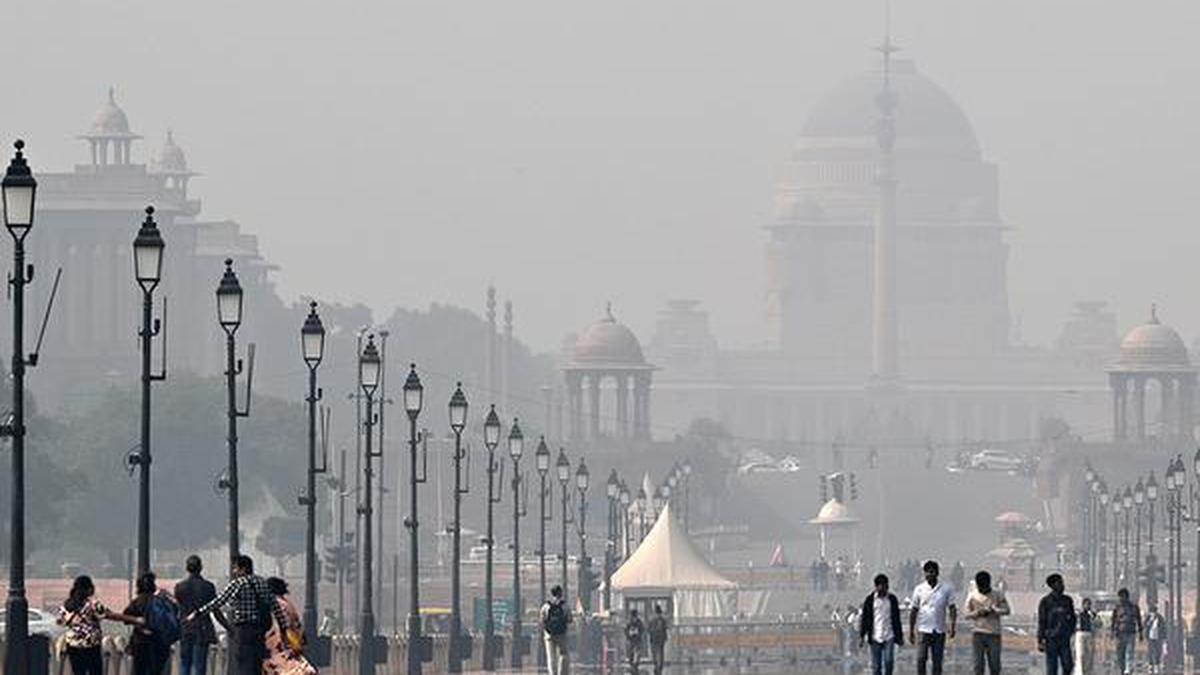
Every winter, Delhi’s Air gets wrapped in a thick grey blanket. People say:
-
“Thand aa gayi, fog aa gaya.”
-
“Ye toh har saal hota hai.”
-
“2–4 din mein clear ho jayega.”
But that “fog” is not fog. It’s smog. And the difference is everything.
-
Fog = clean water droplets in the air.
-
Smoke = dust, chemicals, burned particles, exhaust, toxins.
-
Smog = fog + smoke = a dirty, poisonous gas layer.
It looks romantic in Instagram reels; it behaves like slow poison in your lungs.
The scary part?
We’re not shocked anymore.
We’ve seen headlines like:
-
“Delhi AQI crosses 500”
-
“Most polluted capital in the world”
-
“Severe category air quality”
…so often that we scroll past it like it’s a boring cricket score.
This is exactly how slow destruction works: you stop reacting to it.



2. Oslo vs Delhi’s Air: Same Planet, Different Reality
Picture this.
-
Oslo – capital of Norway
-
One of the cleanest cities in the world
-
Air Quality Index (AQI): single digit, like 6–10
-
-
New Delhi – capital of India
-
One of the most polluted cities in the world
-
AQI in winter: 450–500+, sometimes 700+
-
Now imagine two people:
-
Person A lives 5 years in Oslo
-
Person B lives 5 years in Delhi
Both:
-
Never smoked
-
Had perfectly healthy lungs at the start
-
Eat decent food, do basic exercise, no major disease
In an ideal world, after 5 years:
-
Person A’s lungs are still pink, flexible, clean
-
Person B’s lungs are blackened, inflamed, stiff, filled with microscopic junk
If both had transparent bodies and could stand in front of a mirror and see their lungs…
Delhi would empty out in one week.
It would look like a post-apocalyptic video game.
But the problem is:
We don’t see the damage directly.
So our brain files it under “chalta hai”.
3. Why This Is Worse Than a Crisis – It’s a Trap
Some disasters kill fast.
-
Earthquakes
-
Floods
-
Pandemics like COVID
They are visible. They create panic. They force government and public to respond.
Air pollution is different.
-
It doesn’t drop bodies instantly.
-
It doesn’t make dramatic visuals.
-
It doesn’t show real-time horror.
It works like compound interest in reverse.
Every breath adds:
-
A little more inflammation
-
A little more damage
-
A little more risk
One day that “little” becomes:
-
A heart attack at 45
-
An asthma condition that never existed before
-
A child who can’t run without coughing
-
A 70-year life compressed into 58
The tragedy?
Most people will never link that moment back to “those years in Delhi air.”
They’ll say “kisika naseeb”, “BP problem”, “weak heart”, “family history”.
No. A lot of it is environment history.
4. What Is PM 2.5 – And Why Everyone Should Be Scared of This Number
Whenever air quality is discussed, you see one term everywhere:
PM 2.5
Let’s break it like a human, not like a textbook.
-
PM = Particulate Matter
Tiny solid or liquid particles floating in the air. Too small to see, but always there. -
2.5 = size of the particle
2.5 micrometers or smaller.
That’s 1/30th of the thickness of a human hair.
Now visualise this:
Take one strand of your hair.
Its diameter (not length) is like a road.
On that road, you can place around 30 PM2.5 particles side by side.
That’s how insanely tiny they are.
Because they’re so small:
-
Your nose hair can’t trap them
-
Your throat filters can’t block them
-
They go straight into your lungs
-
From there, some particles enter your bloodstream
-
From blood, they reach everywhere – heart, brain, liver, kidneys
This is why PM2.5 is considered one of the most dangerous components of air pollution globally.
And Delhi’s air is not just “a bit bad”. At severe levels, it’s PM2.5 soup.
5. What Pollution Actually Does Inside Your Body
Let’s talk biology like business.
You have:
-
Lungs = operating system
-
Heart = main pump
-
Blood = logistics network
-
Brain = CEO
-
Immune system = security team
PM2.5 attacks every layer of this system.
5.1 Lungs – From Flexible to Stone
When you keep breathing polluted air:
-
Your lungs get constant tiny injuries
-
Your body sends inflammation to fight
-
Inflammation becomes chronic
-
The lung tissue becomes stiff, scarred, and blackened
Result?
-
Shortness of breath
-
Wheezing
-
Asthma-like symptoms
-
Lower stamina
-
Chronic cough
-
Higher risk of lung infections
-
Increased risk of lung cancer
At some point, your lungs behave less like balloons and more like solid rubber. They simply stop expanding fully.
5.2 Heart + Blood Vessels – Silent “Financial Fraud” on Your Body
Remember the “maida in blood” analogy?
When PM2.5 enters the bloodstream:
-
It thickens your blood
-
It irritates and damages the inner lining of arteries
-
It makes arteries stiffer and narrower
-
It increases chances of clots
This means:
-
Your heart has to work harder to pump blood
-
Your blood pressure creeps higher
-
Risk of heart attack and stroke jumps 20–40% in highly polluted areas
So that “sudden heart attack at 42” you see in the news?
Sometimes it’s not sudden at all.
It’s an EMI of damage, paid breath by breath, in polluted air.
5.3 Brain – The Fog No One Talks About
You think only your lungs breathe pollution?
Your brain is bathing in polluted blood.
PM2.5 can cross the blood–brain barrier, a protective shield that usually keeps bad stuff out.
Once inside, it:
-
Irritates neurons
-
Affects chemical signalling
-
Creates small pockets of inflammation
-
Reduces cognitive sharpness
You feel:
-
Brain fog
-
Low focus
-
Slow thinking
-
Memory lapses
-
Mood swings
-
Higher risk of neurodegenerative diseases over time
And then we wonder why:
-
Kids are unable to focus properly in class
-
Adults feel constantly “drained” mentally
-
Even high-performers feel like their brain is on 60% capacity
5.4 Immunity – Always in Fake “War Mode”
Constant pollution exposure confuses the immune system.
Your white blood cells start behaving like security guards who think there’s a bomb threat 24×7.
-
They stay in attack mode
-
They get tired
-
Their efficiency drops
End result?
-
You fall sick more often
-
Normal cold, cough, flu take longer to heal
-
Allergies become a lifestyle
-
Chronic inflammation becomes your default state
5.5 Fertility, Pregnancy, and the Next Generation
This is where it gets truly dark.
High pollution has been linked to:
-
Lower sperm count and weaker sperm movement in men
-
Poorer egg quality and hormonal imbalance in women
-
Increased risk of miscarriages
-
Slower growth of unborn babies
-
Pollution particles even crossing the placenta and reaching the baby
Imagine this:
A pregnant woman in Delhi walks to the market. She thinks she’s just buying vegetables.
In reality, unseen particles are:
-
Entering her lungs
-
Going into her blood
-
Crossing into the baby’s environment
-
Reaching the developing brain and organs of a child that hasn’t even taken its first breath
That’s how early the EMI of pollution can start.
5.6 Bones, Muscles, Skin – The “Bonus Damage”
Long-term air pollution exposure also contributes to:
-
Weaker bones
-
Slower muscle recovery
-
Faster skin ageing
-
More acne, dullness, pigmentation
-
Higher cancer risks overall
In short: your whole system is paying for something you didn’t even buy.
6. Kids in Delhi: Growing Up in an Invisible War Zone
Now let’s talk about the most vulnerable group:
School-going children.
Here’s something most parents don’t know:
-
Kids breathe more air per kg of body weight than adults
-
Their lungs are still developing
-
Their bodies are more sensitive to toxins
So if:
-
An adult is breathing “700 AQI air”
-
A child in the same area, effectively, is getting hit like it’s “1400 AQI”
Twice the damage.
On smaller, growing lungs.
Studies have shown:
-
Kids in highly polluted cities have 10–20% smaller lung capacity compared to kids growing up in cleaner countries.
-
Millions of children in Delhi already show irreversible lung damage.
Think about the long-term picture:
-
Lower stamina
-
Higher illnesses
-
Reduced cognitive performance
-
Lower productivity across their entire life
We send kids to school to build their future.
Instead, we’re slicing off a chunk of their future just by letting them breathe.
And remember that 13-cigarette equivalent?
Breathing Delhi’s toxic air for a day at extreme AQI is like smoking 13 cigarettes.
No parent will give their kid 13 cigarettes.
But they’ll zip open the school bag and say, “Chalo, late ho rahe ho.”
7. “Band Kar Do School?” – The Half-Answer Everyone Is Fighting Over
Every year, when AQI goes crazy, one debate starts:
“Close schools or not?”
Parents split into 2 groups:
-
Group 1: “Shut schools. Health is more important than education.”
-
Group 2: “If the air is same everywhere, why disturb education?”
The truth is more nuanced. School shutdown only helps if:
-
The child stays indoors all day, doesn’t play outside in the society or street.
-
The room where the child stays has a good air purifier running.
If these two things are not true, then whether school is open or closed doesn’t matter much.
Because:
-
Playground air = street air
-
Society park air = school ground air
-
Your balcony air = main road air
For most middle and lower-middle class families:
-
No air purifiers at home
-
Limited space
-
Kidswill play outside
So shutting schools becomes more emotional than effective, unless the root exposure is managed.
8. The Economics of Air: How Pollution Is a Tax on the Poor
Let’s bring money and business into this.
Pollution is not just a health issue. It’s an economic and class issue.
Who can escape bad air?
-
Rich people:
-
Travel abroad more often
-
Live in better localities
-
Seal their homes
-
Install multiple purifiers
-
Work from home
-
Use air-filtered offices
-
Who can’t?
-
Auto drivers
-
Delivery boys
-
Street vendors
-
Security guards
-
Factory workers
-
Construction labour
-
Kids in government schools
-
Lower-middle class families living in tight homes
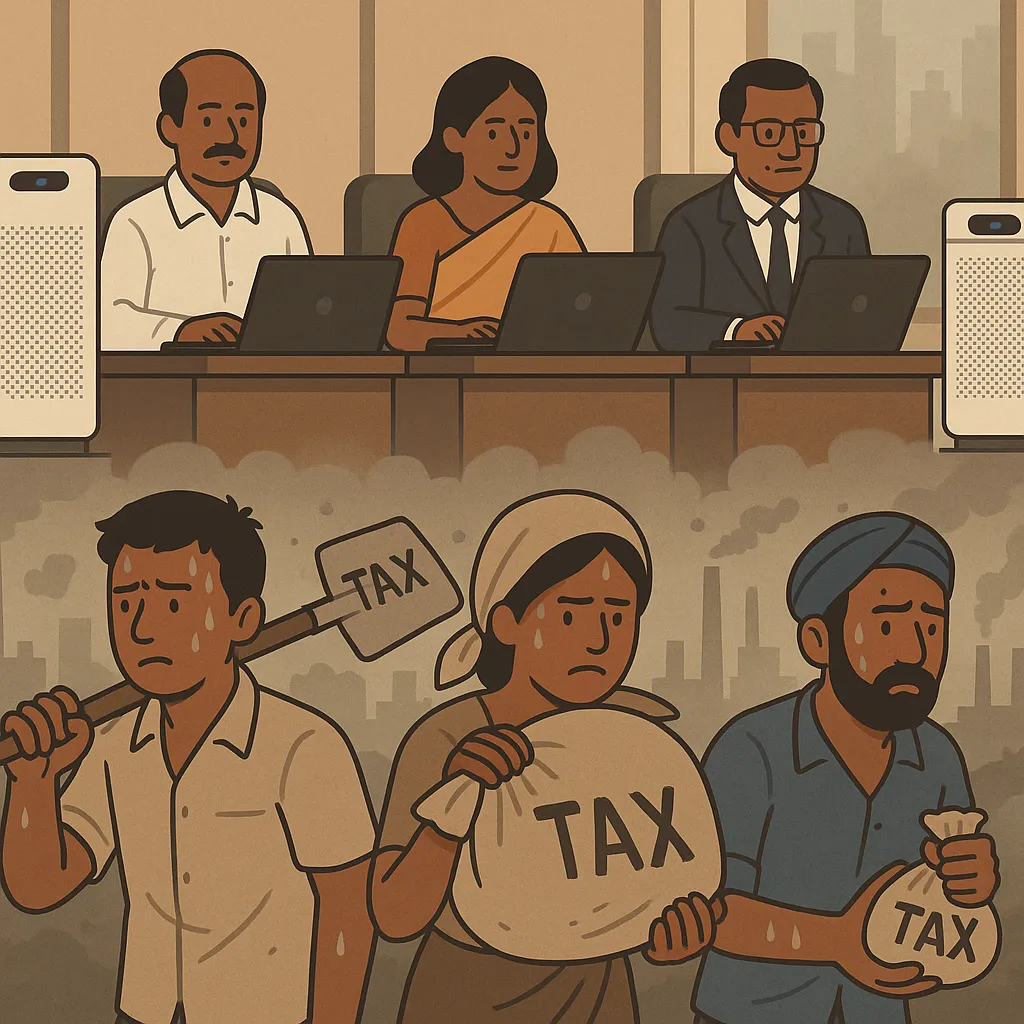
Pollution acts like a secret tax:
-
Rich pay money for purifiers, they gain extra years of life
-
Poor pay in health, productivity, and medical bills later
On top of that:
-
Sick population = sick economy
-
More sick leaves = lower company output
-
More healthcare spending = less investment in education, growth
-
Lower cognitive performance in children = less innovation, weaker workforce later
We love talking about 5 trillion dollar economy, unicorns, big startups.
But million-dollar founders are breathing the same garbage air as the guy doing food delivery at 11 pm. The only difference is:
-
One can buy some protection
-
The other must take the hit raw
From a macro point of view, polluted air is:
-
Killing productivity
-
Increasing healthcare costs
-
Slowing learning
-
Reducing average lifespan
-
Weakening human capital
No serious entrepreneur or policymaker should be okay with that.
9. “Government Kuch Karegi” – The Comfortable Fantasy
A lot of people are in this mode:
-
“Thoda time do, government something will do.”
-
“It’s on news, so obviously they are working on it.”
-
“Courts ne bola hai, toh solve ho jayega.”
Result?
They outsource their survival to:
-
Elections
-
Committees
-
Panels
-
Orders
-
“Long-term action plan”
Problem: pollution is a daily phenomenon.
Your lungs don’t wait for policy files to move.
Governments and agencies can make a difference — big time. Countries have done it. Beijing, for example, aggressively reduced pollution over a few years.
But in India, the:
-
blame game
-
political drama
-
state vs centre fights
-
industry lobbies
-
corruption
all ensure that by the time actual action reaches the ground, an entire generation has already taken the hit.
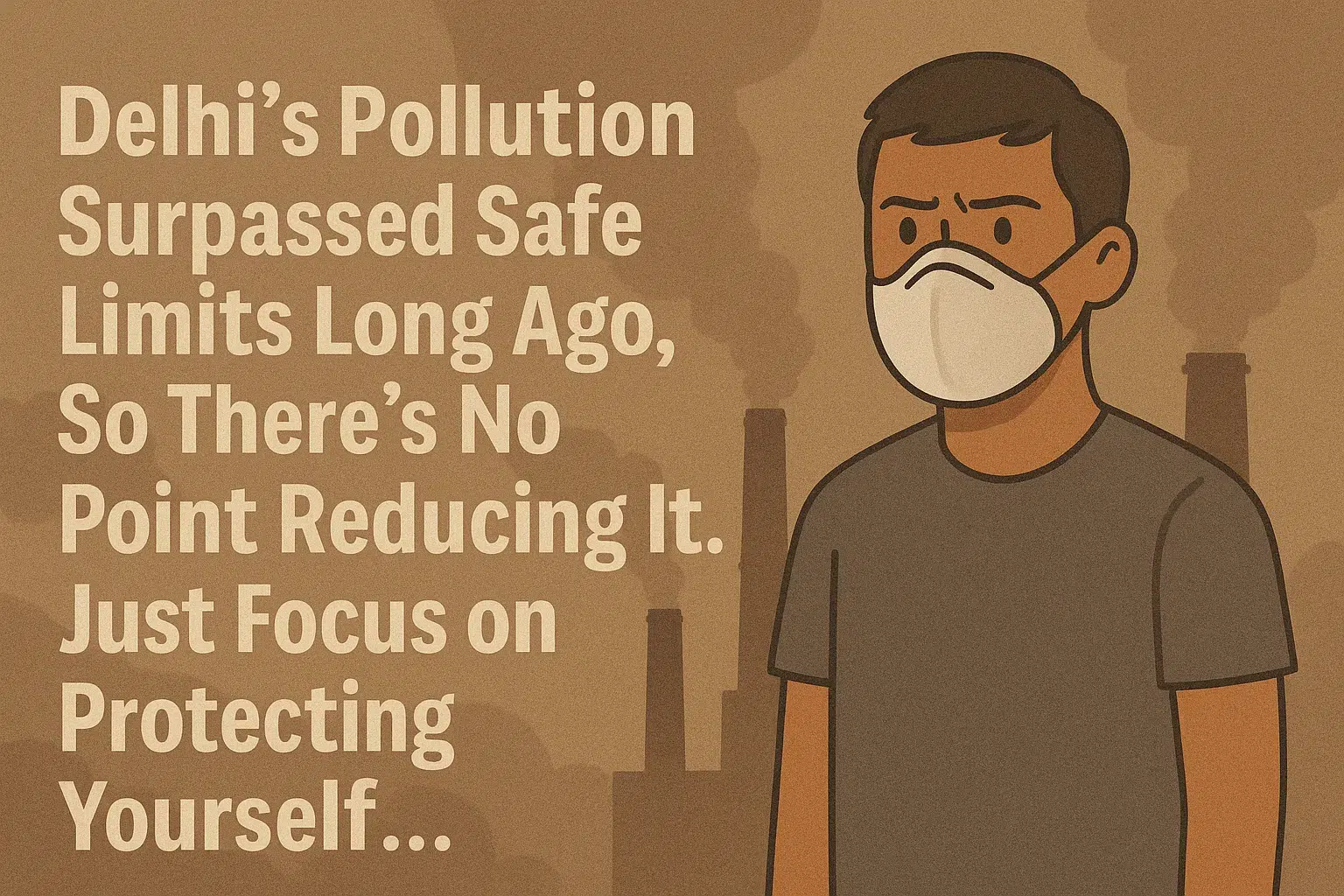
So here’s the harsh message:
Depending fully on the government to protect you from Delhi’s air is not optimism. It’s self-sabotage.
Rely on policy for macro change, sure.
But rely on yourself for survival.
10. Survival Strategy: How to Protect Yourself and Your Family (Realistically)
Let’s get into clear, actionable stuff.
10.1 Shift Your Exercise Timing
Morning 5–10 am in winter =
Peak pollution, low temperature, trapped particles.
-
Worst time to go for a run or jog
-
Your lungs become a PM2.5 vacuum cleaner
Do this instead:
-
Move running / jogging / outdoor workouts to afternoon when AQI is relatively lower.
-
If you must work out in the morning, keep it indoor, well-ventilated, and preferably where air is filtered.
Health and fitness are good.
But “jogging in 500+ AQI” is not gym dedication, it’s biological stupidity.
10.2 Use Proper Masks – Not Fashion Statements
Surgical masks and cloth masks are useless against PM2.5.
They:
-
Stop big droplets (like in COVID type scenarios)
-
Don’t stop micro particles in polluted air
If your city’s AQI is in the danger zone, wear:
-
N95, KN95, or FFP2 type masks
These can block 60–80% of harmful particles.
Is it 100% safe? No.
Is it way better than nothing? Absolutely yes.
Think of it as reducing how many “cigarettes” your lungs are forced to inhale.
10.3 Smart Investment: Air Purifier in at Least One Room
Not everyone can fill their entire house with purifiers. That’s fine.
But if you can stretch your budget, do this:
-
Prioritise bedroom first
You spend 7–9 hours there. That’s almost one-third of your life.
Look for:
-
HEPA H13 or H14 filter
-
CADR (Clean Air Delivery Rate) of 300–400+ if possible
-
Avoid cheap “showpiece purifiers” that are basically fans with filters for marketing
This is not a luxury gadget.
This is health infrastructure.
Don’t compare it to buying a phone.
Compare it to buying extra years of healthy life.
10.4 Ventilate Strategically, Not Emotionally
You do need fresh air.
But you also need to avoid peak poison.
Best window for ventilation in polluted cities:
-
Roughly between 12 pm and 3 pm (midday)
-
When sunlight is strong, air circulation is better, some pollutants disperse
So:
-
Open windows in that time slot to allow exchange
-
Rest of the time, keep windows mostly closed if AQI is severe
-
Don’t leave a purifier on with windows wide open – that’s like running AC with doors open
Think of your room like a mini startup:
-
Optimize input (outside air
-
Filter it
-
Reduce leakages
10.5 Limit Unnecessary Outdoor Time in Peak Toxic Hours
You can’t stop living.
You can’t stop going to work or college.
But you can:
-
Avoid walks / chai breaks / random strolls in peak bad hours
-
Plan grocery runs in noon
-
Avoid standing on main roads for long conversations
-
Choose indoor meetups over roadside hangouts when AQI is insane
It’s not about becoming paranoid.
It’s about cutting down excess, avoidable exposure.
10.6 For Parents: Hard Decisions, Clear Logic
If you are a parent in a polluted city, your decisions are heavier.
Ask yourself:
-
Is there a room in the house with a purifier where the child can spend significant time?
-
Can the child avoid unnecessary outdoor play during extreme AQI days?
-
Are you able to send them to school with a proper mask?
-
Does the school take air quality seriously (air purifiers, indoor activities, etc.)?
If:
-
You have an air-purified environment at home
-
You can manage some form of home learning / online classes
Then keeping the child home temporarily during extreme peaks can make sense.
If:
-
You don’t have purifiers
-
The child will anyway roam outside in the same bad air
-
School has at least some better indoor environment
Then shutting school may add emotional comfort but minimal physical benefit.
Every family situation is different.
The key is: think scientifically, not socially.
11. Mindset Shift: Health as the First Asset Class
We talk a lot about:
-
Equities
-
Mutual funds
-
Real estate
-
Startups
-
Side hustles
But before all that, there’s a more fundamental portfolio:
-
Lungs
-
Heart
-
Brain
-
Immune system
These are your primary assets.
Pollution doesn’t just take “health”.
It takes:
-
Productive hours
-
Focus
-
Energy
-
Years you could have used to work, earn, enjoy
-
Mental sharpness you could have used to build something big
You want billionaire mindset?
Start where billionaires secretly do:
-
Protect time
-
Protect energy
-
Protect health
Everything else multiplies on top of that.
An ambitious Indian in 2025 cannot afford to treat air pollution like a “news topic”.
It’s literally eating into:
-
Your career potential
-
Your earning potential
-
Your lifespan
Treat protection like an investment, not an expense.
12. The Activist Angle: Personal Safety + Public Pressure
There are two tracks:
-
Micro: Protect yourself and your family
-
Macro: Push for systemic change
You need both.
If you only:
-
Take private precautions but stay silent publicly →
You survive better, but the city continues to choke.
If you only:
-
Shout on social media but take no precautions →
You feel woke, but your lungs still lose.
Systemic change may take time, but it doesn’t happen in silence.
Things move when:
-
Parents demand better standards for school air
-
Citizens question why monitoring stations are being “managed”
-
RWAs push for local green zones, better waste management, no garbage burning
-
Professionals and students make this a real issue, not a seasonal hashtag
Pollution doesn’t trend on its own.
It needs people willing to stay loud even after winter is over.
13. The Harsh Truth: You Can Run a Startup, But You Can’t Outsmart the Air
You can:
-
Outsmart a competitor
-
Outsmart an exam
-
Outsmart market timing
But you cannot outsmart constant toxic air with pure optimism.
Hustle culture sounds nice on reels:
-
“Work till your lungs give up”
-
“Grind 24×7”
-
“No days off”
Nice caption.
Very bad life plan — especially in a city where your lungs are already under attack by default.
Real hustle in a polluted city looks like:
-
Working hard
-
But also actively reducing environmental damage
-
Taking your health metrics seriously
-
Checking your city’s AQI like you check stock prices
-
Using logic, not vibes, to decide when to go for that 6 am run
The point is not to become scared.
The point is to become strategic.
14. So, What Now? A Simple Framework You Can Actually Use
Let’s close this with a concrete, no-nonsense framework.
14.1 Step 1: Awareness
-
Check AQI daily (like checking weather).
-
Understand what PM2.5 and AQI ranges mean.
-
Accept that this is not a “phase” — this is reality for now.
14.2 Step 2: Baseline Protection
-
Use N95/KN95 in high AQI days, especially on roads.
-
Shift workouts to safer times.
-
Limit non-essential outdoor time in peak bad hours.
14.3 Step 3: Home Strategy
-
If possible, install at least one good purifier in the bedroom.
-
Close windows during peak times, ventilate in safer windows (12–3 pm approx).
-
Keep indoor dust low, avoid indoor smoking, burning incense excessively, etc.
14.4 Step 4: Health Monitoring
-
If you’re in a polluted city long-term:
-
Get periodic health checks: lungs, heart, basic blood work.
-
Don’t ignore chronic cough, breathlessness, frequent cold.
-
-
For kids:
-
Watch their stamina and cough patterns.
-
Talk to paediatricians about long-term air exposure.
-
14.5 Step 5: Voice + Action
-
Support or start local initiatives: no garbage burning, more trees, cleaner construction practices.
-
Raise questions on local representatives’ performance on pollution.
-
Make this topic part of real conversations — not just small talk in winters.
15. The Delhi’s Air Is Quiet, the Damage Is Not
Delhi right now is a live case study of what happens when:
-
Ambition is high
-
Development is fast
-
But environmental intent is weak
We’re building roads, towers, malls, offices, startups.
We’re also building:
-
Black lungs
-
Weak hearts
-
Slower brains
-
A generation that will pay interest on our negligence
The line that really needs to stay in your mind is this:
Air doesn’t kill you in headlines. It kills you in silence.
If you’re young, ambitious, hungry to build something — mindset, money, business — then treating your lungs as an optional upgrade is not just naive, it’s self-destructive.
Take control where you can.
Protect what you can.
Push for what must change.
Because till the day our leaders’ intentions are as clean as the air in Oslo, you and I have to fight two battles:
-
One inside our bodies
-
One outside, in the system
And both start with one simple shift:
Stop treating this as “weather”. Start treating this as “life and death compounding”.
Useful References and Further Reading
1. Central Pollution Control Board – Real-Time AQI
Official Indian government portal showing current AQI across all cities.
https://app.cpcbccr.com/ccr/#/caaqm-dashboard-all/caaqm-landing
2. SAFAR India – Ministry of Earth Sciences
Detailed pollution forecasts, sources, and scientific data for major Indian cities.
http://safar.tropmet.res.in/
3. World Air Quality Index Project (WAQI)
Global real-time AQI map, comparisons across countries and cities.
https://waqi.info/
4. IQAir – Air Quality Ranking & Reports
International rankings, PM2.5 reports, and health impact summaries.
https://www.iqair.com/in-en/world-air-quality-ranking
5. WHO – Air Pollution & Health Overview
World Health Organization’s official insights on pollution, PM2.5, and health risks.
https://www.who.int/health-topics/air-pollution
6. NASA Earth Observatory – Pollution Maps & Studies
Satellite imagery and scientific explanation of global air pollution patterns.
https://earthobservatory.nasa.gov/
7. Lancet Commission – Pollution & Global Health Report
Comprehensive research on how air pollution affects longevity and disease.
https://www.thelancet.com/commissions/pollution-and-health
8. India Meteorological Department (IMD)
Weather updates that affect pollution dispersion and winter smog formation.
https://mausam.imd.gov.in/
Frequently Asked Questions About Delhi’s Air
1. Why is Delhi’s air so polluted every winter?
Delhi’s air becomes extremely toxic in winter because of a deadly combination of factors: crop burning in neighbouring states, low wind speed, temperature inversion, vehicle emissions, construction dust, and industrial smoke. All these pollutants get trapped close to the ground, creating dense smog.
2. Is Delhi’s air really harmful to health?
Yes. Delhi’s air regularly crosses the “hazardous” category. High PM2.5 levels damage your lungs, heart, blood vessels, brain, skin, and even fertility. Long-term exposure can reduce life expectancy by 8–12 years.
3. What does PM2.5 mean in Delhi’s air quality reports?
PM2.5 means “Particulate Matter smaller than 2.5 micrometers.” These particles are so tiny they bypass your nose and lungs’ natural filters, enter your bloodstream, reach the brain, and cause chronic inflammation and diseases.
4. Is it safe to exercise outdoors when Delhi’s air quality is bad?
No. Running or heavy breathing outdoors during high AQI makes your lungs inhale far more pollutants. It’s safer to shift workouts indoors or to afternoon hours when the AQI slightly improves.
5. How can I protect myself from Delhi’s air pollution?
Use N95 or KN95 masks outdoors, install a HEPA air purifier (H13/H14) at home—at least in the bedroom, keep windows closed during peak smog hours, ventilate only between 12–3 pm, and avoid unnecessary outdoor exposure on severe days.
6. Are children more affected by Delhi’s air than adults?
Yes. Children breathe more air per kg of body weight, and their lungs are still developing. Delhi’s toxic air causes smaller lung capacity, higher asthma risk, cognitive decline, and long-term health issues in kids.
7. Does Delhi’s air pollution affect mental performance?
High PM2.5 levels can cross into the brain and cause inflammation. This leads to slower thinking, brain fog, memory issues, reduced focus, mood swings, and lower cognitive performance.
8. Can air purifiers really help in Delhi?
Good purifiers with HEPA H13/H14 filters significantly reduce indoor PM2.5 levels. They can’t fix outdoor air, but they can drastically improve the air you breathe for 8–10 hours a day inside your home—especially in bedrooms.
9. Why doesn’t the government declare Delhi’s air crisis a national emergency?
Because air pollution kills slowly, not instantly. It doesn’t create dramatic visuals like floods or pandemics. Slow disasters rarely get urgent political action, and bureaucratic delays, blame games, and corruption worsen the situation.
10. Is moving out of Delhi the only solution?
Not for everyone. Many people can’t relocate. The practical path is: minimise exposure, protect your home environment, improve your personal air quality, and push publicly for systemic change. But yes—cleaner cities do offer significantly better long-term health outcomes.
Find Our More Posts : Read Here
Delhi’s Air
Sushant Kumar
Founder
As a current B.Com (Hons) student at DU SOL and an active Chartered Accountancy (CA) aspirant, I understand the exact pressure, syllabus confusion, and administrative hurdles students face daily. TheSushant.in was built to provide first-hand, stress-tested guidance. Every DU SOL update, exam strategy, and CA study note shared here comes directly from my personal academic journey, official notifications, and real-time student experience. No generic advice: practical, student-to-student blueprints to help you clear your exams and level up.