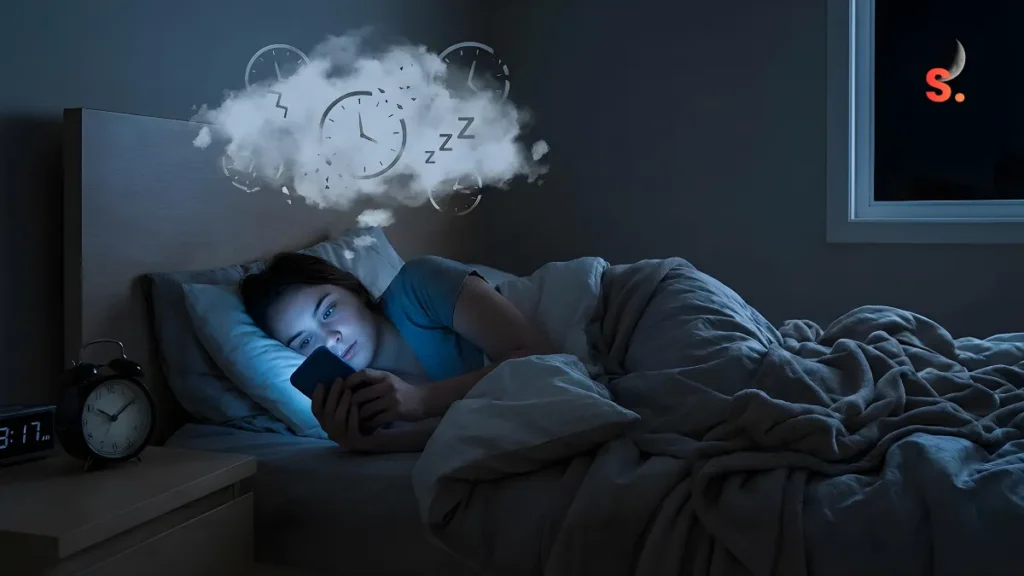
A broken sleep cycle is one of the most common problems among students. Late-night studying, phone use, irregular classes, stress about exams, and inconsistent routines slowly push sleep out of alignment.
Most students try to fix it using shortcuts: pulling all-nighters, sleeping all day on weekends, or forcing sleep with exhaustion. These methods usually make the problem worse.
This article explains:
-
What a “broken” sleep cycle actually means
-
Why students’ sleep cycles get disturbed
-
What works, what doesn’t, and why
-
Practical ways to fix sleep step by step
-
Realistic timelines and consequences
No promises. Just biology, habits, and logic.
What a Broken Sleep Cycle Actually Means
A broken sleep cycle does not mean insomnia or a medical disorder in most cases.
For students, it usually means:
-
Sleeping very late (2–5 a.m.) and waking late
-
Feeling sleepy during the day but alert at night
-
Difficulty falling asleep even when tired
-
Irregular sleep timing (different every day)
-
Poor sleep quality despite long hours in bed
The key issue is timing, not effort.
Your body has an internal clock called the circadian rhythm.
It decides when you feel sleepy and when you feel alert.
When this clock is misaligned with your daily life (college, exams, daylight), sleep feels “broken.”
Why Student Sleep Cycles Get Disturbed

1. Late-Night Screen Exposure
Phones, laptops, and LED lights suppress melatonin, the hormone that signals sleep.
The issue is not just “screen addiction.”
It’s that bright light at night tells the brain: it is still daytime.
Scrolling at 1 a.m. delays sleep even if your body is tired.
2. Studying Late as a Habit, Not a Need
Many students study late at night because:
Over time, the brain associates night = focus and day = rest, reversing the natural rhythm.
3. Inconsistent Wake-Up Time
Sleeping late is not the main problem.
Waking up at different times every day is.
Examples:
-
7 a.m. on weekdays
-
11 a.m. on weekends
-
9 a.m. during holidays
This confuses the biological clock and prevents stable sleep.
4. Weekend Sleep Recovery (Oversleeping)
Students often try to “recover” sleep on weekends.
In reality:
Sleep timing matters more than total hours.
5. Stress Without Physical Exhaustion
Mental stress alone does not always produce sleep.
If your day involves:
-
Sitting
-
Screens
-
Thinking
-
Anxiety
Your mind is tired, but your body is not.
This mismatch delays sleep.
Common Myths That Make Sleep Worse
Myth 1: “I’ll sleep early once exams are over”
Sleep does not reset automatically.
Your brain learns patterns, not promises.
Myth 2: “I’m a night owl”
True biological night owls are rare.
Most students become night-active due to habits, not genetics.
Myth 3: “I just need more willpower”
Sleep is regulated by hormones and light exposure, not motivation.
Trying harder rarely works.
Myth 4: “I’ll fix it by pulling one all-nighter”
This may reset sleep once, but usually causes:
-
Extreme fatigue
-
Irregular naps
-
Rebound insomnia
It’s unreliable and risky.
What Actually Fixes a Broken Sleep Cycle
There is no instant fix.
There is a process.
The goal is to retrain your internal clock, not force sleep.
Step 1: Fix Your Wake-Up Time (Not Bedtime)
This is the most important step.
Choose a realistic fixed wake-up time and stick to it daily, including weekends.
For most students:
6:30–7:30 a.m. is practical.
Even if you sleep at 3 a.m., wake up at the chosen time.
What happens:
Do not compensate by sleeping late the next day.
Step 2: Get Morning Light Exposure
Within 30–60 minutes of waking:
This signals the brain to start the day cycle and set the clock for night sleep.
Indoor lights are not enough.
Step 3: Stop Napping (At Least Temporarily)
Naps reduce sleep pressure.
If sleep is broken:
This is uncomfortable but necessary during reset.
Step 4: Create a “Sleep Wind-Down Zone”
Sleep does not begin at bedtime.
It begins 2–3 hours earlier.
After a fixed evening time (for example, 9 p.m.):
This does not mean “relax completely.”
It means lower stimulation.
Light revision > heavy problem-solving.
Step 5: Use Bed Only for Sleep
Many students:
-
Study on bed
-
Scroll on bed
-
Watch videos on bed
The brain learns: bed = activity.
For reset:
This retrains association.
Step 6: Physical Movement During the Day
You do not need intense exercise.
But you do need:
-
Walking
-
Standing
-
Mild physical fatigue
At least 30–60 minutes of movement during the day improves night sleep.
Avoid heavy workouts after 8 p.m.
Step 7: Eat on a Fixed Schedule
Irregular meals confuse the body clock.
Try:
Avoid heavy meals late at night.
How Long Does It Take to Fix a Sleep Cycle?
Realistic timelines:
-
Mild disruption: 7–10 days
-
Moderate disruption: 2–3 weeks
-
Severe (months/years): 3–6 weeks
Progress is gradual, not sudden.
Expect:
Consistency matters more than perfection.
Consequences of Not Fixing Sleep as a Student
Short-term effects:
-
Poor concentration
-
Weak memory retention
-
Increased anxiety
-
Reduced productivity
Long-term effects:
Sleep issues rarely stay isolated.
They spill into health, discipline, and confidence.
When to Consider Medical Help
Most student sleep issues are behavioral.
However, seek medical advice if:
-
You cannot sleep even when exhausted
-
Sleep is broken despite consistent routine
-
There is loud snoring or breathing issues
-
Anxiety or depression symptoms are severe
Avoid self-medicating with sleeping pills.
My Perspective
Fixing a broken sleep cycle is not about discipline or motivation.
It is about alignment.
Your body wants regularity.
It responds to light, timing, and repetition.
As a student, sleep is not optional recovery time.
It is part of your learning system.
Once sleep stabilizes, most other problems—focus, energy, routine—become easier to manage, not because life improves, but because your brain works the way it is supposed to.
This is not a quick fix.
It is a structural correction.
And structural corrections last.
How to Stay Consistent in Studies: Science-Backed Tips 2026